The bipolar membrane is a new type of ion-exchange membrane, which consists of an anion exchange layer, a cation exchange layer and an intermediate interface layer. This unique structure endows the bipolar membrane with special properties and working principles.
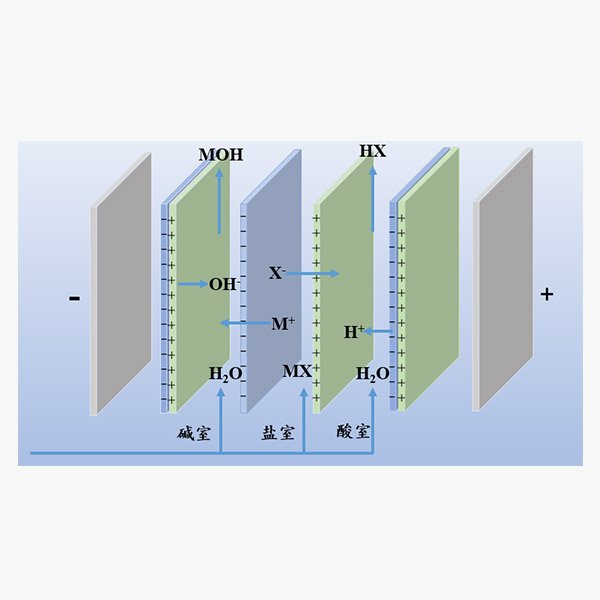
When an electric field is applied to both sides of the bipolar membrane, water molecules will dissociate in the middle interface layer, generating hydrogen ions (H⁺) and hydroxide ions (OH⁻). The hydrogen ions will migrate towards the cathode through the cation exchange layer, while the hydroxide ions will migrate towards the anode through the anion exchange layer. During this process, the bipolar membrane can separate the cations and anions in the salt solution by transporting them to different regions, thus achieving ion separation.
Traditional methods of ion separation, such as precipitation, solvent extraction, and ion exchange resin methods, although they met the industrial demands of the past to a certain extent, have increasingly revealed their drawbacks as science and technology advance and application scenarios expand.
The precipitation method usually requires the addition of a large amount of chemical reagents, which not only may cause secondary pollution but also increases the cost and difficulty of subsequent treatment. Moreover, for some ions with high solubility, the precipitation effect is not ideal and complete separation is difficult to achieve.
Although the solvent extraction method has high selectivity, the use of organic solvents poses safety risks and can cause environmental pollution. Additionally, the phase separation operation during the extraction process is quite complex and requires a significant amount of energy and time.
The ion exchange resin method has certain limitations in terms of ion exchange capacity and the regeneration process. The exchange capacity of the resin is limited, and frequent regeneration is required, which not only increases the operating cost but also may lead to a decline in the resin's performance. Moreover, for some complex ion mixed systems, the selectivity of the ion exchange resin is not high enough, making it difficult to achieve precise separation.
Compared with traditional ion-exchange membranes, the advantage of bipolar membranes lies in their ability to achieve efficient separation and conversion of ions through their own hydrolysis without the addition of external acid or base reagents. This self-driven separation process not only reduces the use of chemical reagents, lowers costs and environmental pollution, but also has higher energy utilization efficiency.
The bipolar membrane, as an innovative ion separation technology, offers a practical and feasible solution to break through the limitations of traditional separation methods.
Shanghai Sanji New Materials Technology Co., Ltd. will continue to increase its investment in the research and development of bipolar membranes, continuously improving the performance and quality of the products, expanding the application fields, and providing customers with better products and services. At the same time, the company will actively cooperate with domestic and foreign research institutions and enterprises to jointly promote the development and application of bipolar membrane technology, and make greater contributions to achieving the sustainable development of the chemical industry.